Hello!
Wanting to share some reflections today on Cassandra Syndrome/OTRS.
Learning about Cassandra Syndrome (or OTRS – Ongoing Trauma Relationship Syndrome or Affective Deprivation Disorder) was a groundbreaking discovery about me when my partner discovered he’s autistic in 2014 and we’d been married for 15 years already.
Called a number of different things by different people/organisations over the last 10 years or so, it’s a collection of symptoms that can develop from experiencing the following relational circumstances:
- insufficient social/emotional understanding and reciprocity,
- persistent and cumulative mental/emotional stress,
- living with inflexibility,
- denial and invalidation of your experience and
- navigating unknown difference
It manifests as social isolation, deteriorating mental, emotional, social and physical wellbeing, unconsciously behaving more like your partner, self-doubt and a distorted sense of self.
Whilst historically and typically applied to neurotypical partners in a relationship with someone who’s autistic, this same set of circumstances and symptoms can be experienced by neurodivergent individuals too. It can also be experienced by those in relationships that include other experiences of unknown neurodiversity than autistic, e.g. ADHD.
Many people I meet who are in a neurodiverse relationship, regardless of their neuro-identity, are experiencing versions of PTSD (from specific traumatic/stressful events) and/or cPTSD (from ongoing/persistent stress or combination of specific and persistent) that I support them to recover from… and live into healthier relationship with themselves and beyond that with their loved ones.
As I’ve lived further into the map of neurodiversity and understood how the Pathology Paradigm and dominant narratives about neurodiversity have been operating in that map, I’ve noticed growing resistance to the language, descriptions and attribution (not the descriptions or experience which are very real) of Cassandra Syndrome/OTRS.
In some places, associated mainly with neurotypical females, this kind of cPTSD, in a relationship that’s featured unknown neurodiversity, has been named Cassandra Syndrome/OTRS. In my own lived experience, and as a Coach, I have seen this experienced by all neuro-identities and all genders… it is a more universal experience (by which I mean all kinds of people, not everyone) than the current narrative supports.
Symptoms of Cassandra Syndrome/OTRS and the impact of unknown neurodiversity are reversible once you know about it.
The symptoms described by Cassandra Syndrome/OTRS are a reaction to a situation you didn’t know you were in. It can be reversed. With new knowledge, insight, awareness, perspectives, tools and strategies, you can unravel the mystery, of the relationship and yourself, restore your wellbeing and begin to live with purpose and flourish.
This is exactly what I support clients to do now and the results are spectacular. Clients have called the impact of my coaching as ‘indescribable in such a short amount of time’ and their new experience as ‘unimaginably different’.
There is another way. A happier now and future is possible.
The most painful thing is losing yourself in the process of loving someone and forgetting that you are special too. It’s liberating and empowering to discover that change starts with you then ripples outwards into your relationships and your life.
Do you recognise the symptoms of Cassandra Syndrome in yourself or the relational circumstances I’ve described above? Are you interested in how coaching can support you to begin reversing the impact and symptoms of unknown neurodiversity in less than 10 days?
Finding your way forward
Perhaps something you’ve read here has helped you see your experience a little differently, put words to something you’ve been feeling, or glimpse a new possibility for yourself.
Whatever has brought you here, you deserve space to understand your experience, recover your energy and find your way forward at your own pace.
That’s what Be You Coaching is all about.
Reignite Roadmap is your first step into Be You — a gentle, guided introduction to the journey of moving from relationship exhaustion towards brave clarity, with space to reconnect with yourself and discover what might be possible.
CLICK to explore Reignite Roadmap
With love and sparkle
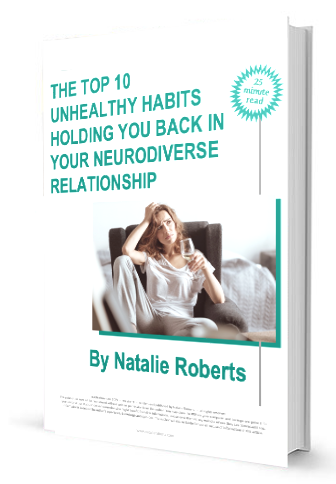
Get Your Free Report On The Top 10 Unhealthy Habits That Hold You Back in Your Neurodiverse Relationship … and Tips For A Happier Life